All posts by ntiadmin
Uqausirngaq Policy
Nunavut Inuit Post-Secondary Education Program Policy
Policy on the Administration of Distinctions-Based Funding
Compassionate and Bereavement Travel Program
Employee Housing Policy
NTI Isolation Kit Program
For Immediate Release:
NTI Isolation Kit Program
(January 7, 2022) Nunavut Tunngavik Inc. (NTI) provides support to Inuit who have been diagnosed with COVID-19, are required to isolate for 14 days as a result of contact tracing and are in a Nunavut community with active COVID-19 cases. It is vital that we all follow the public health measures that are put in place by Nunavut’s Chief Public Health Officer (CPHO) which includes whole household isolation requirements if you have been diagnosed with COVID-19 or asked to isolate as a result of contact tracing or have experienced symptoms of COVID-19.
Isolation Kits are intended to support Nunavut Inuit to stay home. The content of these kits depends on the information provided to NTI and will be adapted based on dietary needs, number of adults and children in the household and infant specific needs.
For communities with confirmed cases, isolation kit applications do not require signature by a health care provider. All other Nunavut communities and Inuit living outside of the Nunavut Settlement Area require a signature by the health care provider. Any information provided will be strictly confidential. The Isolation Kit program is a voluntary program. The NTI Isolation Kit Program was developed with the Government of Canada’s Indigenous Community Support Funding.
To ensure anonymity, supplies and supports will not be given unless the affected person(s) fill out the isolation kit application form. The application form can be printed or filled out online at https://covid19.tunngavik.com/nti-isolation-kit-form/
Please note, supplies and supports may be delayed due to the rising number of COVID-19 cases in Nunavut, local store hours and the impacts of weather and other programs on Nunavut’s Supply Chain. We are working very hard with partners and stakeholders to deliver the Isolation Kit Program. NTI will process approved application forms in the order they are received. NTI staff and suppliers in each community thank you for your understanding and patience.
If your household has already received an isolation kit, you are not eligible to reapply for the same period.
For more information on NTI’s Isolation Kit Program, please call toll free 1-888-924-3757 or email COVID-19@tunngavik.com or website at COVID19.tunngavik.com
For further information:
Karen Flaherty
A/Director Communications
Nunavut Tunngavik Incorporated
Tel: (867) 975-4900/Toll-free: 1-888-924-3757
www.tunngavik.com
NTI President’s Awards
(November 15, 2021 – Rankin Inlet, Nunavut) – The President of Nunavut Tunngavik Incorporated recognized three Inuit who’ve made significant contributions in promoting the economical, social, and cultural well-being of fellow Inuit. Each recipient is presented with an award and cheque for $500.00.
At the 2021 NTI Annual General Meeting, President Aluki Kotierk recognized and thanked the following Inuit for their contributions:
Lucy Netser, Salliq
Lucy Netser actively contributes to the well-being of her community. She has been actively involved in keeping Inuit culture and practices alive by teaching younger Inuit, in the way she was taught, how to prepare skins, sew kamiik and other traditional clothing. Lucy also counsels’ youth and other community members through stresses and hardships. Through her involvement with the Anglican church, Lucy held weekly 2-hour radio shows in Arviat while the community was hit with positive cases of COVID-19 and in strict lockdown. She did so to offer messages of encouragement to the community.
Makabe Nartok – Kugaaruk
Makabe Nartok is being recognized for his cultural contributions to his community of Kugaaruk, the Kitikmeot region, across Nunavut, Canada and abroad in Arctic Sports. Makabe has been participating and competing in arctic sports since the 1970s and continues to be involved as a teacher and mentor for Inuit youth to this day. Makabe holds the world record for the Airplane, reaching just over 168ft at the Whitehorse Arctic Winter Games in 1986.
Joseph Ikoo Angutikjuak – Kangiqtugaapik
Joseph Ikoo Angutikjuak is a leader and the oldest member of his community. He is very vocal and shares hunting stories and Inuit knowledge regularly over the local radio. He does so to ensure Inuit values and skills are passed down to the next generation of Inuit, and to ensure Kangiqtugaapingmiut know about unsafe hunting conditions on the land. Joseph has shared his knowledge with the Government of Nunavut over the years to help develop an education curriculum for Nunavut schools that is founded on Inuit language, culture, traditions, and worldview.
-30-
For further information:
Malaya Mikijuk
Director of Communications Trainee
Nunavut Tunngavik Incorporated
Tel: (867) 975-4900/Toll-free: 1-888-646-0006
www.tunngavik.com
Financial Support for External Legal Challenges
Request for Submission for Logo Design
The Makigiaqta Inuit Training Corporation is seeking the creation of a logo/visual identity that captures a vision in hosting career awareness camps. The career awareness camps will be hosted with various partners to raise awareness on the career opportunities for young Nunavummiut. At present, plans are underway for science, health and finance career camps.
This logo will be used on various websites, Facebook pages, promotional information and all swag items for youth participants and the organizing partners. We are seeking a timeless logo that will capture:
• Inuit tools and traditional ways moving towards a modern era
• Inspiring young people? Possibility? Opportunities for the future?
• Simplicity
• Youth connection?
TARGET AUDIENCE
The logo should be appealing to youth ages 12 – 15 years.
REQUIREMENTS
A successful submission will include the following elements:
I. A logo design with: a) a graphic element; and, b) the words “Career Awareness Camps,” in both landscape and portrait orientations.
II. A brand palette with at least 4 colors. Note: Present all items above in both: a) full color; and, b) black and white.
III. An alignment with the Makigiaqta Inuit Training Corporation logo
IV. Royalty-free access to all the source and vector files
COLOUR PALETTE AND FONT STYLE
Applicants can create a palette that is reflective of Nunavut and Canada’s Arctic, and a font style that is appealing to youth.
PRIZE…
$5,000 will be awarded to the artist that designs the logo selected.
There will be two prizes of $1,000 for other designs submitted.
SUBMISSION CLOSING DATE:
by November 26, 2021.Contact Information
PUBLIC SERVICE ANNOUNCEMENT
Start time: October 15, 2021
End time: October 31, 2021
Coral Harbour, Nunavut
Nunavut Tunngavik Inc. (NTI) would like to advise the residents of Coral Harbour that Isolation Kit delivery may be delayed due to the high volume of applications and the local store inventory.
If you have applied for the isolation kit online, you do not need to call and confirm, staff are processing applications as quickly as they can.
It is preferred that you apply online with the online forum provided on the NTI website. Please include your House Number for delivery, not your PO Box number.
Applications cannot be prioritized and cannot be delivered on the same day – applications are processed as they come in, applicants are notified once their application has been processed.
Isolations kits are limited to one per household.
Thank you for your patience and understanding.
Department of Inuit Programs and Services
PO Box 280
Rankin Inlet, NU X0C 0G0
Toll-free: 888-646-5400
Phone: 867-645-5400
Email: COVID-19@tunngavik.com
Website address for applications:
https://covid19.tunngavik.com/initiatives/covid-19-isolation-kits/
REQUEST FOR PROPOSALS
NUNAVUT TUNNGAVIK INCORPORATED
REQUEST FOR PROPOSALS
Introduction
Nunavut Tunngavik Incorporated (NTI), the land claims organization for Inuit in Nunavut, is requesting proposals from qualified proponents to perform the following work (the “Work”):
The Department of Research, Monitoring and Evaluation would like to better understand the Nunavut research regulatory landscape and to highlight Inuit involvement in various research licensing processes.
A. Instructions to Proponents
1. Proposals must be received by NTI no later than 5:00 p.m. ET on November 8, 2021 (the “Closing Deadline”) at the following address:
Nunavut Tunngavik Inc.
Attention: Jean Allen, Senior Research Advisor (the “Contact Person”)
3rd Floor, Igluvut Bldg. P.O. Box 638
Iqaluit, NU X0A 0H0
Tel: (867) 975-4950
2. Proposals must be submitted via email under the following conditions:
• The e-mailed proposal must be received on or before the closing date at the e-mail address stated in this Request for Proposals (RFP).
• To ensure that the proposal is received before the closing date, it is recommended that it be sent by e-mail well in advance of the closing date, and that the proponent confirm receipt by return e-mail or by telephone inquiry.
3. NTI will not accept liability for any claim, demand or other actions for any reason should an e-mail transmission be interrupted, not received in its entirety, received after the stated closing time and date, or for any other reason.
4. NTI will not consider any proposal that:
• Is delivered after the closing date or time.
• Is delivered to any address other than that provided above.
After the closing date, only the identity and addresses of the proponents will be made public.
5. Proponents must address any questions to the Contact Person by e-mail. Questions will be accepted until the Closing Deadline. Questions and answers will be made available to all invited bidders.
6. This is an RFP: It is not a tender or an offer. NTI is not bound to accept any proposal or the proposal that provides for the lowest cost or price.
7. NTI has the right to cancel this RFP at any time and to reissue it for any reason whatsoever, without incurring any liability and no proponent shall have any claim against NTI as a consequence.
8. If a contract is awarded as a result of this RFP, it shall be awarded to the proponent who is most responsive and whose proposal provides the best potential value to NTI. A proponent who is “responsive” is one who best meets the requirements described in this RFP and possesses the ability to perform fully the requirements of the Work.
9. The negotiation and execution of a written agreement shall constitute the making of a contract. No proponent shall acquire any legal or equitable rights or privileges whatsoever under this RFP until the contract is signed.
10. The contract will contain relevant provisions from this RFP, from the accepted proposal, as well as other terms that may be mutually agreed upon, whether arising from the accepted proposal or as a result of any negotiations. NTI reserves the right to negotiate modifications with any proponent who has submitted a proposal.
11. In the event of any inconsistency between this RFP and the ensuing contract, the contract shall govern.
12. Any amendments made by NTI to this RFP will be issued in writing and sent to all who have received the documents.
13. NTI is not liable for any costs of preparation or presentation of proposals.
14. An evaluation committee consisting of NTI staff and/or contractors will review the proposals. NTI reserves the exclusive right to determine the qualitative aspects of all proposals relative to the evaluation criteria including the ability to request more information from or to negotiate with one or more proponents.
15. Proponents may amend their proposal up to the Closing Deadline. A proposal may not be amended after the Closing Deadline, but may be withdrawn by the proponent at any time prior to acceptance.
16. NTI encourages the use of Inuit goods/services/businesses, labour, and training of Inuit labour and will provide adjustments to the above factors in the evaluation of proposals.
17. A listing of approved Inuit Firms can be obtained from NTI Inuit Firm Secretariat.
18. Proposals may be short-listed. Proponents whose proposals are short-listed may be requested to make a formal presentation. Such presentations shall be made at the cost of the proponent.
19. The proposal and accompanying documentation submitted by the proponent become the property of NTI and will not be returned. It is expected that a winning proposal may be identified by November 26, 2021 by 5:00 p.m. ET.
20. Vendors whose offers have been rejected will receive written notification within approximately ten (10) business days of the selection.
B. Terms of Reference
Background
The research regulatory landscape in Nunavut is complex and involves a number of research licensing authorities, none of which are governed by Inuit. In order to better understand how Inuit self-determination could be advanced in Nunavut, a better understanding of the different research licensing, permitting, and authorization processes and the various levels of involvement of Inuit in these processes is greatly needed.
The Work
The successful proponent will:
1. Conduct background research on existing research licensing processes in Nunavut.
2. Work with NTI and partners to develop a short questionnaire for research licensing authorities.
3. Contact Nunavut research licensing authorities to collect information on their research licensing processes and the involvement of Inuit in these various processes (i.e., communication, application review, decision-making, etc.).
4. Follow-up with Inuit organizations/societies if necessary to verify their role in various research licensing processes.
5. Collect and compile information and prepare a report.
Proponent(s)
We are seeking experienced contractors who are familiar with the research regime in Nunavut and have experience providing high-quality work regarding research in Nunavut.
Tentative Project Schedule/Timeline
Expected deliverables and associated timelines are as follows:
1. Background Review to be submitted within 2 months of approval
2. Questionnaire to be submitted prior to dissemination
3. Draft Report to be submitted on or before February 14, 2022
4. Final Report to be submitted on or before February 28, 2022
C. Proposal Evaluation
Evaluation Criteria
The proposals will be evaluated according to the following criteria:
1. Project approach and work plan: 20%
2. Project team’s knowledge, skill and experience: 20%
3. Fees and expenses: 30%
4. Use of Inuit Labour: 20%
5. Proven ability to meet deadlines: 10%
Total: 100% (100 points)
1. Project approach and work plan
The proponent must provide a detailed outline illustrating the approach to the Work that demonstrates the following:
• Adherence to the terms and conditions of the RFP.
• An understanding of the project requirements and “deliverables.”
• An approach to the project that will meet project requirements.
• A detailed work plan, to include tasks to be completed, and project controls.
2. Project team’s knowledge, skill and experience
The proponent must provide a detailed description of the project team’s organizational and managerial competence, with references to previously completed successful projects of a similar nature. The proponent must also address their specific qualifications, knowledge and experience that it believes make it the suitable candidate for the Work. The proponent is encouraged to include detail qualifications of each team members who will work on the project.
3. Fees and Expenses
The proposal must include a detailed statement of the charges to be incurred. The proposal should provide an outline of the preferred billing arrangements and include a description of a standard invoice. Costs must be stated in Canadian funds.
This portion of the criteria is subject to adjustments for Inuit Firms for the purpose of evaluation:
1) Inuit Firms, registered on NTI’s Inuit Firm Registry, will receive an adjustment (Inuit Firm Adjustment) of 20 per cent on the fees and expenses component of the contract proposal.
2) Inuit Firms must provide details of their Inuit Firm status in order to receive an Inuit Firm Adjustment.
3) Pro-Rating of Inuit Firm Adjustment
Contract proposals must include details concerning all sub-contractors, including the Fees and Expenses attributable to the subcontractor. The Inuit Firm Adjustment shall not be applied to any portion of the contract proposal where the work is to be subcontracted to a non-Inuit firm. The Inuit Firm Adjustment may be applied to those contract proposals made by non-Inuit firms with respect to any portion of the contract proposal where the work is to be subcontracted to an Inuit Firm.
4. Use of Inuit Labour
Contract proposals demonstrating the use of Inuit labour (directly or through sub-contractor) will receive up to 20 per cent of the overall available points. In order to receive the adjustment for use of Inuit labour, contract proposals must include details concerning proposed use of Inuit labour by the proponent and all sub-contractors. Additional reporting will be required from the successful proponent on the actual use of Inuit labour after the contract is awarded and failure to implement the proposed Inuit labour target may result in a penalty. Being an Inuit Firm is not a pre-condition to receive points under this category.
5. Proven ability to meet deadlines
The ability to meet all deadlines on this project is critical. The proposal must demonstrate how the firm has consistently met all deadlines in the past and must provide two references.
REQUEST FOR PROPOSALS
REQUEST FOR PROPOSALS
Data Management Needs Assessment and Recommendations for Inuit Post-Secondary Education
Introduction
Nunavut Tunngavik Incorporated (NTI) is requesting proposals from qualified proponents to conduct a needs assessment and subsequently recommend requirements and a scope of work for a Request for Proposals to support the procurement of a data management software system. The data management software will support data collection and management in order to measure and monitor implementation of the National Inuit Post-Secondary Education (IPSE) Strategy.
This work will be solicited under the direction of the department of Social and Cultural Development at NTI.
A. Instructions to Proponents
1. Proposals must be received by NTI via email no later than 5 p.m. EST on October 29, 2021 at the following address:
Nunavut Tunngavik Inc.
Attention: Papatsi Kotierk
Education and Language Policy Analyst
Tel: (867) 975-7586
• The e-mailed proposal must be received on or before the closing date at the e-mail address stated in this RFP, including a subject line as: Data Management Needs Assessment for Inuit Post-Secondary Education.
• To ensure that the proposal is received before the closing date, it is recommended that it be sent by e-mail well in advance of the closing date, and that the proponent confirm receipt by return e-mail or by telephone inquiry.
3. NTI will not accept liability for any claim, demand or other actions for any reason should an e-mail transmission be interrupted, not received in its entirety, received after the stated closing time and date, or for any other reason.
4. NTI will not consider any proposal that:
• Is delivered after the closing date or time.
• Is delivered to any address other than that provided above.
After the closing date, only the identity and addresses of the proponents will be made public.
. Questions will be accepted until October 15, 2021 at 5 p.m. EST.6. This is an RFP: It is not a tender or an offer. NTI is not bound to accept any proposal or the proposal that provides for the lowest cost or price.
7. NTI has the right to cancel this RFP at any time and to reissue it for any reason whatsoever, without incurring any liability and no proponent shall have any claim against NTI as a consequence.
8. If a contract is awarded as a result of this RFP, it shall be awarded to the proponent who is most responsive and whose proposal provides the best potential value to NTI. A proponent who is “responsive” is one who best meets the requirements described in this RFP and possesses the ability to perform fully the requirements described in the RFP.
9. The negotiation and execution of a written agreement shall constitute the making of a contract. No proponent shall acquire any legal or equitable rights or privileges whatsoever under this RFP until the contract is signed.
10. The contract will contain relevant provisions from this RFP, from the accepted proposal, as well as other terms that may be mutually agreed upon, whether arising from the accepted proposal or as a result of any negotiations. NTI reserves the right to negotiate modifications with any proponent who has submitted a proposal.
11. In the event of any inconsistency between this RFP and the ensuing contract, the contract shall govern.
12. Any amendments made by NTI to this RFP will be issued in writing and sent to all who have received the documents.
13. NTI is not liable for any costs of preparation or presentation of proposals.
14. An evaluation committee will review each proposal. NTI reserves the exclusive right to determine the qualitative aspects of all proposals relative to the evaluation criteria.
15. Proponents may amend their proposal up to the closing date and time by email. A proposal may not be amended after the closing date but may be withdrawn by the proponent at any time prior to acceptance.
16. NTI encourages the use of goods and services offered by Inuit Firms, labour and training of Inuit, and will be given preferential considerations to the above in any evaluation of a proposal.
17. A listing of Inuit Firms can be obtained online: https://inuitfirm.tunngavik.com
18. Proposals and accompanying documentation submitted by the proponent become the property of NTI and will not be returned. It is expected that a winning proposal may be identified by November 12, 2021 by 5 p.m. EST.
19. Proponents whose offers have been rejected will receive written notification within approximately ten business days of the selection.
B. Terms of Reference
Nunavut Tunngavik Incorporated (NTI) is the Land Claim Organizations that represents Nunavut Inuit with Inuit Tapiriit Kanatami. ITK supports coordination and implementation of the National IPSE Strategy in partnership and collaboration with its members: Inuvialuit Regional Corporation, Makivik Corporation, and Nunatsiavut Government.
Specifically, NTI created the Nunavut IPSE Steering Committee as a forum for collaboration, sharing, learning, and when applicable, coordination of IPSE funding allocated to Nunavut from the National IPSE Strategy. The Nunavut IPSE Steering Committee consists of members from NTI, Qikiqtani Inuit Association, Kakivak Association, Kivalliq Inuit Association and Kitikmeot Inuit Association.
To streamline information sharing, reporting, and program evaluation, a shared data management system between NTI and the three regional delivery organizations was identified as a priority need in the coming fiscal year.
This scope of work involves two major tasks, a Data Management Needs Assessment and recommendation of RFP requirements for the development of Data Management Software to be utilized by the Nunavut IPSE Steering Committee.
Data Management Needs Assessment
The regional delivery agents may have unique technical and program specifications, as well as the possibility of other priorities and programs to be integrated into a new shared data management system. The needs assessment will seek to understand, at minimum:
• How delivery agents are currently collecting, analyzing, and storing relevant information;
• What historical data needs to be hosted on a shared server;
• An analysis into the viability in integration of financial software with the shared data system is required. It would be preferred if the shared data system could accurately track financial data and automatically notify administrators of predefined events or send out alerts when thresholds have been crossed;
• Data transfer capabilities between platforms;
• Reporting requirements to the Federal Government, NTI, and other Inuit partners; and
• Security, confidentiality and infrastructure requirements.
The needs assessment will be completed through, interviews and discussions with key representatives at NTI, the regional delivery organizations, and others to understand regional needs, priorities, and specifications regarding a shared data management system.
The consultant shall provide NTI with a summary report of the common and unique needs and priorities of NTI and the regional delivery organizations.
RFP Development
Once the needs assessment is completed, the consultant will develop an RFP to find a suitable Software Platform or Developer. The RFP will meet, at minimum, the needs of the National IPSE Strategy and Funding as determined by the needs assessment.
Final specifications may vary. If the project differs from the description above, a final price will be renegotiated with the proponent upon notification of changes.
C. Schedule
Date of issue:
September 24, 2021
Notice of Intent:
October 8, 2021 at 5:00 p.m. EDT
Closing Date and Time for Inquiries:
October 15, 2021 at 5:00 p.m. EDT
Final Response to Inquiries:
October 22, 2021 at 5:00 p.m. EDT
Date and Time for Final Submission:
October 29, 2021 at 5:00 p.m. EDT
Award of Contract:
November 12, 2021 at 5:00 p.m. EDT
Project Start (preferred):
November 15, 2021
Interim Progress Reports:
Bi-weekly
Draft Reports:
TBC (Based on Workplan)
Final Reports:
February 1, 2022 (Based on Workplan)
The Needs Assessment and a draft RFP must be completed by February 1, 2022 for review and approval.
D. Bid Evaluation and Inuit Firm Adjustment
The proposals will be evaluated according to the following criteria:
1. Needs assessment and RFP development approach, work plan – 20%
2. Project team’s knowledge and skill: 30%
3. Fees and expenses: 20%
4. Use of Inuit Labour: 20%
5. Proven ability to meet deadlines: 10%
Total: 100% (100 points)
1. Needs assessment and RFP development approach, work plan and project team’s knowledge and skill
The proponent must provide a complete outline illustrating the approach to completing the needs assessment and RFP development that demonstrates the following:
• Adherence to the terms and conditions of the RFP.
• An understanding of the scope of the needs assessment and “deliverables.”
• An approach to completing the needs assessment and RFP development that will meet the project requirements.
• Organizational and managerial competence.
• A detailed work plan, to include tasks to be completed, and project controls.
• References with respect to previously completed successful reports of a similar nature must be included, with contact information provided (names, addresses and telephone numbers).
The proponent must also address their specific qualifications, knowledge and experience that it believes make it the suitable candidate for this assignment. The proponent is encouraged to include detailed qualifications of each team members who will work on the project.
2. Fees and Expenses
The proposal should provide an outline of the preferred billing arrangements and include a description of a standard invoice. The proposal must include a detailed statement of the charges to be incurred. Costs must be stated in Canadian funds.
3. Use of Inuit Labour
Contract proposal demonstrating the use of Inuit labour (directly or through sub-contractor) will receive up to 20 per cent of the overall available points. In order to receive the adjustment for use of Inuit labour, contract proposals must include details concerning proposed use of Inuit labour by the proponent and all sub-contractors. Additional reporting will be required from the successful proponent on the actual use of Inuit labour after the contract is awarded and failure to implement the proposed Inuit labour target may result in a penalty.
4. Ability to meet deadlines
The ability to meet all deadlines on the finalization of the report is critical. The proposal must demonstrate how the firm has consistently met all deadlines in the past and must provide two references.
E. Inuit Firm Adjustment
1. Inuit Firms, registered on NTI’s Inuit Firm Registry, will receive an adjustment (Inuit Firm Adjustment) of 20 per cent on the design and production costs component of the contract proposal (excluding GST and shipping).
2. Inuit Firms must provide details of their Inuit Firm status in order to receive an Inuit Firm Adjustment.
3. Pro-Rating of Inuit Firm Adjustment. Contract proposals must include details concerning all sub-contractors, including the fees and expenses attributable to the subcontractor. The Inuit Firm Adjustment shall not be applied to any portion of the contract proposal where the work is to be subcontracted to a non-Inuit firm. The Inuit Firm Adjustment may be applied to those contract proposals made by non-Inuit firms with respect to any portion of the contract proposal where the work is to be subcontracted to an Inuit firm.
Uqqujjait Innarnut Elders Support Policy
Medium Term Investment Policy
Short Term Investment Policy
NHSP Community Hunt Policy
NHSP Harvesting Equipment Policy
Nunavut Tunngavik Incorporated – Request for Proposals
Nunavut Tunngavik Incorporated (NTI), the land claims organization for Inuit in Nunavut, is requesting proposals from qualified proponents to perform the following work (the “Work”):
from qualified web development firms to carry out the complete redesign of NTI’s website located at https:// tunngavik.com. This includes: Graphic Design, Front-end content management, Back-end Content Management, Online resource development, Web Application Development, and Security Design. The timeframe for completion of the newly designed website is tentatively scheduled to launch in October of 2022.
Iqaluit COVID-19 Walk-in Vaccination Clinic
Iqalummiut ages 12 and older will be able to receive their COVID-19 vaccine during a Walk-in Clinic, July 14 – 16 from 1:00 to 10:00 pm daily, at the Curling Rink.
The City of Iqaluit is providing door prizes worth $500 for Distancing Outdoors, Stay-at-Home Baking and Home Cleaning and Sanitizing.
Inuit will receive a $25 voucher from Nunavut Tunngavik Incorporated (NTI) after each dose.
Call Caribou Cabs at 979-4444 for a ride to the clinic. Taxi vouchers will be available.
The Iqaluit COVID-19 Walk-in Vaccination Clinic is a partnership of NTI, Qikiqtani Inuit Association, the Government of Nunavut and the City of Iqaluit with support provided by Qaujigiartiit Health Research Centre, Astro Theatre, and Uvagut TV.
For further information:
Karen Flaherty
A/Director of Communications
Nunavut Tunngavik Incorporated
Tel: (867) 975-4900/Toll-free: 1-888-646-0006
Will Hopkins
Acting Director Communications
Qikiqtani Inuit Association
Tel: (867)975-8413
Lisa Milosavljevic
Communications and Customer Service Manager
City of Iqaluit
Tel: 867-979-5607
Cate Macleod
Press Secretary to Premier Savikataaq
Government of Nunavut
Tel: (867) 975-5059
#NUday2021
President Kotierk – Video
Iqaluit COVID-19 Walk-in Vaccination Clinic
Iqalummiut ages 12 and older will be able to receive their COVID-19 vaccine during a Walk-in Clinic, June 16 – 19 from 1:00 to 10:00 pm daily, at the Curling Rink.
The City of Iqaluit is providing door prizes worth $500 for Distancing Outdoors, Stay-at-Home Baking and Home Cleaning and Sanitizing.
Inuit will receive a $25 voucher from Nunavut Tunngavik Incorporated (NTI) after each dose.
Call Caribou Cabs at 979-4444 for a ride to the clinic. Taxi vouchers will be available.
The Iqaluit COVID-19 Walk-in Vaccination Clinic is a partnership of NTI, Qikiqtani Inuit Association, the Government of Nunavut and the City of Iqaluit with support provided by Qaujigiartiit Health Research Centre, Astro Theatre, Uvagut TV and a team of Nunatsiavut Nurses.
-30-
For further information:
Karen Flaherty
A/Director of Communications
Nunavut Tunngavik Incorporated
Tel: (867) 975-4900/Toll-free: 1-888-646-0006
Will Hopkins
Acting Director Communications
Qikiqtani Inuit Association
Tel: (867)975-8413
Lisa Milosavljevic
Communications and Customer Service Manager
City of Iqaluit
Tel: 867-979-5607
Cate Macleod
Press Secretary to Premier Savikataaq
Government of Nunavut
Tel: (867) 975-5059
Request for Proposal
REQUEST FOR PROPOSALS – Logistics Strategy
Nunavut Tunngavik Incorporated (NTI) is requesting proposals from qualified proponents to develop a high quality, fully-implementable logistics strategy and plan for the Qanuippitaa? National Inuit Health Survey for Nunavut, to be implemented prior to the expected delivery of the Survey in the fall/winter 2021.
The requested timeline for deliverables for a Logistics Needs Assessment Report is by May 21, 2021, and a Logistical Plan by July 2, 2021.
Table of Contents
A. Instructions to Proponents
B. Terms of Reference
C. Fees and Expenses
D. Inuit Firm Bid Adjustment
A. Instructions to Proponents
1. Proposals must be received by NTI no later than 5 p.m. EST on March 19, 2021 at the following address:
Nunavut Tunngavik Inc.
Nunavut Health Survey Manager
3rd Floor, Igluvut Bldg. P.O. Box 638
Iqaluit, NU X0A 0H0
Tel: (867) 975-4962 Fax: (867) 975-4943
• The e-mailed proposal must be received on or before the closing date at the e-mail address stated in this Request for Proposals (RFP), with the subject line: Logistics Strategy, QHS.
• To ensure that the proposal is received before the closing date, it is recommended that it be sent by e-mail well in advance of the closing date, and that the proponent confirm receipt by return e-mail or by telephone inquiry.
3. NTI will not accept liability for any claim, demand or other actions for any reason should an e-mail transmission be interrupted, not received in its entirety, received after the stated closing time and date, received by any other fax unit other than at the fax address stated above, or for any other reason.
4. NTI will not consider any proposal that:
• Is delivered after the closing date or time.
• Is delivered to any address other than that provided above.
After the closing date, only the identity and addresses of the proponents will be made public.
. Questions will be accepted until March 12, 2021 at 5 p.m. ET.6. This is a RFP: It is not a tender or an offer. NTI is not bound to accept any proposal or the proposal that provides for the lowest cost or price.
7. NTI has the right to cancel this RFP at any time and to reissue it for any reason whatsoever, without incurring any liability and no proponent shall have any claim against NTI as a consequence.
8. If a contract is awarded as a result of this RFP, it shall be awarded to the proponent who is most responsive and whose proposal provides the best potential value to NTI. A proponent who is “responsive” is one who best meets the requirements described in this RFP and possesses the ability to perform the requirements fully described in the RFP.
9. The negotiation and execution of a written agreement shall constitute the making of a contract. No proponent shall acquire any legal or equitable rights or privileges whatsoever under this RFP until the contract is signed.
10. The contract will contain relevant provisions from this RFP, from the accepted proposal, as well as other terms that may be mutually agreed upon, whether arising from the accepted proposal or as a result of any negotiations. NTI reserves the right to negotiate modifications with any proponent who has submitted a proposal.
11. In the event of any inconsistency between this RFP and the ensuing contract, the contract shall govern.
12. Any amendments made by NTI to this RFP will be issued in writing and sent to all who have received the documents.
13. NTI is not liable for any costs of preparation or presentation of proposals.
14. An evaluation committee will review each proposal. NTI reserves the exclusive right to determine the qualitative aspects of all proposals relative to the evaluation criteria.
15. Proponents may amend their proposal up to the closing date and time by email. A proposal may not be amended after the closing date, but may be withdrawn by the proponent at any time prior to acceptance.
16. NTI encourages the use of Inuit goods, services, labour, and training of Inuit labour in any evaluation of a proposal.
17. A listing of approved Inuit firms can be obtained https://inuitfirm.tunngavik.com.
18. The proposal and accompanying documentation submitted by the proponent become the property of NTI and will not be returned. It is expected that a winning proposal may be identified by April 2, 2021 by 5 p.m. ET.
19. Proponents whose offers have been rejected will receive written notification within approximately ten business days of the selection date.
B. Terms of Reference
The 2018 federal government committed $82 million dollars over 10 years and $6 million/year for the Qanuippitaa? National Inuit Health Survey (the Survey) to enable Inuit regions across Inuit Nunangat to develop high quality, Inuit-led and Inuit-owned health research to monitor change, identify gaps and inform decision-making, leading to indicators to improve health and wellness among Inuit in Canada.
The Survey is being implemented by the national Inuit Organizations at the national and regional levels, including core and regional components to the development of the survey, with the objective of further surveys every five years for long-term monitoring.
The Survey will be conducted by household interviews or within the community, through random selection of Inuit, cross-referenced to include all household samples.
Interviews to collect aggregate data for the Survey will begin in the fall/winter of 2021, by interviewers who travel to communities by air.
Logistics Needs
The proponent should be able;
• To develop a Nunavut QNIHS Logistics Plan that consists of strategies for recruitment, hiring, training of field staff, travel, survey administration, contingency planning, and overall implementation of the Logistics Plan prior to the Survey.
• To conduct an assessment in all Nunavut communities of existing resources (personnel, physical space, equipment, etc.) and identify resource gaps for data collection to inform a logistics plan.
• Working with the Government of Nunavut, a clinical needs assessment of existing resources at community health centres.
• To compile desired level of community involvement in data collection (i.e., lead, co-lead, coordination, assistance, awareness) to inform field team requirements.
• Recommend a survey field team for each Nunavut region based on the community needs assessment.
• Recommend a survey logistics schedule and travel plans for survey field staff, based on the community needs assessment and feedback from NTI and partners.
• To provide options and an assessment of those options on how best to deliver the Survey in Nunavut (2-3 options are expected).
The proponent will be expected to be responsible for developing a comprehensive and co-ordinated logistics plans by identifying logistical needs that is realistic, feasible and appropriate for delivery of the Survey in Nunavut.
C. Proposal Evaluation
The proposals will be evaluated according to the following criteria:
1. Report development approach, work plan, project team’s knowledge and skill: 40%
2. Fees and expenses: 30%
3. Use of Inuit Labour: 20%
4. Proven ability to meet deadlines: 10%
Total: 100% (100 points)
1. Report development approach, work plan and project team’s knowledge and skill
The proponent must provide a complete outline illustrating the approach to the project that demonstrates the following:
• Adherence to the terms and conditions of the RFP.
• An understanding of the project requirements and “deliverables.”
• A sound, comprehensive approach to the project that will meet project requirements.
• Organizational and managerial competence, including experience with logistics planning and coordination in Nunavut.
• A detailed work plan, to include tasks and phases to be completed with achievable milestones, and project controls, including review meetings with NTI and partners at key points
• Budget and budget justification that fit with the project description and milestones.
• References with respect to previously completed successful projects of a similar nature must be included, with contact information provided (names, addresses and telephone numbers).
2. Fees and Expenses
The proposal should provide an outline of the preferred billing arrangements and include a description of a standard invoice. The proposal must include a detailed statement of the charges to be incurred. Costs must be stated in Canadian funds.
3. Use of Inuit Labour
Contract proposal demonstrating the use of Inuit labour (directly or through sub-
contractor) will receive up to 20 per cent of the overall available points. In order to receive the adjustment for use of Inuit labour, contract proposals must include details concerning proposed use of Inuit labour by the proponent and all sub-contractors. Additional reporting will be required from the successful proponent on the actual use of Inuit labour after the contract is awarded and failure to implement the proposed Inuit labour target may result in a penalty.
4. Ability to meet deadlines
The ability to meet all deadlines on this project is critical. The proposal must demonstrate how the firm has consistently met all deadlines in the past and must provide two references.
D. Use of Inuit Firms
1. Inuit firms, registered on NTI’s Inuit Firm Registry, shall receive a bid adjustment (Inuit Firm Bid Adjustment) of 10% on the fees and expenses component of the contract proposal.
2. Inuit firms must provide details of their Inuit firm status in order to receive an Inuit firm bid adjustment.
3. Pro-Rating of Inuit firm bid adjustment:
• Contract proposals must include details concerning all sub-contractors, including the fees and expenses attributable to the subcontractor.
• The Inuit firm bid adjustment shall not be applied to any portion of the contract proposal where the work is to be subcontracted to a non-Inuit firm.
• The Inuit firm bid adjustment may be applied to those contract proposals made by non-Inuit firms with respect to any portion of the contract proposal where the work is to be subcontracted to an Inuit firm.
Request For Proposals – State of Inuit Culture and Society
REQUEST FOR PROPOSALS
Report Writing
Nunavut Tunngavik Incorporated (NTI) is Requesting for Proposals (RFP) from qualified proponents to compile and write an annual report on State of Inuit Culture and Society for 2018/2019, providing a twenty-five year overview between the periods of 1993-2018 focusing on whether Inuit self-reliance, social and cultural well-being have improved or declined since the signing of the Nunavut Agreement.
The annual report on the State of Inuit Culture and Society will be solicited under the direction of the department of Social Cultural Development at NTI.
Table of Contents
A. Instructions to Proponents
B. Terms of Reference
C. Fees and Expenses
D. Inuit Firm Bid Adjustment
A. Instructions to Proponents
1. Proposals must be received by NTI via email no later than 5 p.m. EST on March 19, 2021 at the following address:
Nunavut Tunngavik Inc.
Attention: Tina DeCouto
Director of Social and Cultural Development
Tel: (867) 975-7576
• The e-mailed proposal must be received on or before the closing date at the e-mail address stated in this RFP, including a subject line as: Status of Inuit Culture and Society Report.
• To ensure that the proposal is received before the closing date, it is recommended that it be sent by e-mail well in advance of the closing date, and that the proponent confirm receipt by return e-mail or by telephone inquiry.
NTI will not accept liability for any claim, demand or other actions for any reason should an e-mail transmission be interrupted, not received in its entirety, received after the stated closing time and date, or for any other reason.
4. NTI will not consider any proposal that:
• Is delivered after the closing date or time.
• Is delivered to any address other than that provided above.
After the closing date, only the identity and addresses of the proponents will be made public.
. Questions will be accepted until March 12, 2021 at 5 p.m. EST.6. This is an RFP: It is not a tender or an offer. NTI is not bound to accept any proposal or the proposal that provides for the lowest cost or price.
7. NTI has the right to cancel this RFP at any time and to reissue it for any reason whatsoever, without incurring any liability and no proponent shall have any claim against NTI as a consequence.
8. If a contract is awarded as a result of this RFP, it shall be awarded to the proponent who is most responsive and whose proposal provides the best potential value to NTI. A proponent who is “responsive” is one who best meets the requirements described in this RFQ and possesses the ability to perform fully the requirements described in the RFP.
9. The negotiation and execution of a written agreement shall constitute the making of a contract. No proponent shall acquire any legal or equitable rights or privileges whatsoever under this RFP until the contract is signed.
10. The contract will contain relevant provisions from this RFP, from the accepted proposal, as well as other terms that may be mutually agreed upon, whether arising from the accepted proposal or as a result of any negotiations. NTI reserves the right to negotiate modifications with any proponent who has submitted a proposal.
11. In the event of any inconsistency between this RFP and the ensuing contract, the contract shall govern.
12. Any amendments made by NTI to this RFP will be issued in writing and sent to all who have received the documents.
13. NTI is not liable for any costs of preparation or presentation of proposals.
14. An evaluation committee will review each proposal. NTI reserves the exclusive right to determine the qualitative aspects of all proposals relative to the evaluation criteria.
15. Proponents may amend their proposal up to the closing date and time by email. A proposal may not be amended after the closing date but may be withdrawn by the proponent at any time prior to acceptance.
16. NTI encourages the use of goods, services offered by Inuit Firms, labour and training of Inuit labour, and will be given preferential considerations to the above in any evaluation of a proposal.
17. A listing of Inuit Firms can be obtained online: https://inuitfirm.tunngavik.com
18. Proposals and accompanying documentation submitted by the proponent become the property of NTI and will not be returned. It is expected that a winning proposal may be identified by April 2, 2021 by 5 p.m. EST.
19. Proponents whose offers have been rejected will receive written notification within approximately ten business days of the selection.
B. Terms of Reference
Nunavut Tunngavik Incorporated is mandated, fulfilling the Nunavut Social Development Council’s role, to prepare and submit annual report on the state of Inuit culture and society for the year 2018/2019 (Article 32.3.4).
This RFP is to select a proposal that would assist NTI in fulfilling its’ obligation to publish an annual report on the State of Inuit Culture and Society (SICS Report), providing a twenty-five year overview between the periods of 1993-2018 focusing on particular themes of whether Inuit self-reliance, social and cultural well-being has improved or declined, in the following areas;
• Inuktut language,
• Inuit participation in the development of social and cultural policies, and the design of social and cultural programs and services,
• Inuit educational attainment, training and employment,
• Social and cultural indicators on education, health, justice system, child welfare, housing and economic status
The annual report should also contain an evaluation on whether the current governance structures effectively serve Inuit, and whether progress has been made to improve Inuit lives socially, culturally and economically as envisioned in Nunavut Agreement, and in accordance with their rights and expectations, including exploring alternative structures such as self-determination and self-governance.
Final specifications may vary. If the project differs from the description above, a final price will be renegotiated with the proponent upon notification of changes.
C. Tentative Schedule
The draft report must be completed by June 4, 2021 for NTI to review and provide feedback and provide a final report by September 30, 2021.
D. Bid Evaluation and Inuit Firm Adjustment
The proposals will be evaluated according to the following criteria:
1. Report development approach, work plan, project team’s knowledge and skill: 40%
2. Fees and expenses: 30%
3. Use of Inuit Labour: 20%
4. Proven ability to meet deadlines: 10%
Total: 100% (100 points)
1. Report development approach, work plan and project team’s knowledge and skill
The proponent must provide a complete outline illustrating the approach to report writing that demonstrates the following:
• Adherence to the terms and conditions of the RFP.
• An understanding of the report requirements and “deliverables.”
• An approach to the report writing that will meet the report requirements.
• Organizational and managerial competence.
• A detailed work plan, to include tasks to be completed, and project controls.
• References with respect to previously completed successful reports of a similar nature must be included, with contact information provided (names, addresses and telephone numbers).
The proponent must also address their specific qualifications, knowledge and experience that it believes make it the suitable candidate for the development of the report. The proponent is encouraged to include detailed qualifications of each team members who will work on the project.
2. Fees and Expenses
The proposal should provide an outline of the preferred billing arrangements and include a description of a standard invoice. The proposal must include a detailed statement of the charges to be incurred. Costs must be stated in Canadian funds.
3. Use of Inuit Labour
Contract proposal demonstrating the use of Inuit labour (directly or through sub-contractor) will receive up to 20 per cent of the overall available points. In order to receive the adjustment for use of Inuit labour, contract proposals must include details concerning proposed use of Inuit labour by the proponent and all sub-contractors. Additional reporting will be required from the successful proponent on the actual use of Inuit labour after the contract is awarded and failure to implement the proposed Inuit labour target may result in a penalty.
4. Ability to meet deadlines
The ability to meet all deadlines on the finalization of the report is critical. The proposal must demonstrate how the firm has consistently met all deadlines in the past and must provide two references.
E. Inuit Firm Adjustment
1. Inuit Firms, registered on NTI’s Inuit Firm Registry, will receive an adjustment (Inuit Firm Adjustment) of 15 per cent on the design and production costs component of the contract proposal (excluding GST and shipping).
2. Inuit Firms must provide details of their Inuit Firm status in order to receive an Inuit Firm Adjustment.
3. Pro-Rating of Inuit Firm Adjustment
Contract proposals must include details concerning all sub-contractors, including the fees and expenses attributable to the subcontractor. The Inuit Firm Adjustment shall not be applied to any portion of the contract proposal where the work is to be subcontracted to a non-Inuit firm. The Inuit Firm Adjustment may be applied to those contract proposals made by non-Inuit firms with respect to any portion of the contract proposal where the work is to be subcontracted to an Inuit firm.
Message from Acting President James Eetoolook on Covid-19
NTI Election nomination period reconfirmed for November 2-13, 2020
Chief Returning Officer (CRO) Kathleen Sigurdson announced today that the nomination period for the election of President is confirmed to be November 2 to 13, 2020, as printed in the candidate’s handbook and nomination forms. The extended period will enable some candidates to obtain their Criminal Record Check from the RCMP detachments, which are running on a reduced schedule due to COVID-19, and solve any inconsistency in previous election announcements or material.
Candidates must file their nomination papers with the CRO no later than November 13, 2020, 5 p.m. local time and are responsible for ensuring that nomination papers are received. Candidates have until November 16, 2020 at 5 p.m. local time to withdraw
their nomination.
Nomination forms for the election of President are available from the Chief Returning Officer (CRO) Kathleen Sigurdson, Community Liaison Officers (CLO), Ayaya Communications (Office of the CRO), or from NTI’s website.
For more info, or to pick up forms:
https://elections.tunngavik.com/
Kathleen Sigurdson
Chief Returning Officer (CRO)
Rankin Inlet, NU, X0C 0G0
Local Tel: 867-645-6716
Toll Free: 1-844-979-6554
Nadia Ciccone
Office of the CRO – Ayaya Communications
Building 157, Iqaluit, NU, X0A 0H0
Tel: 867-979-1484
Fax: 867-979-1487
Jose Amaujaq Kusugak Scholarship Application Period Opens
(August 20, 2020, Iqaluit, Nunavut) Nunavut Tunngavik Inc. (NTI) President Aluki Kotierk announced today that the Jose Amaujaq Kusugak Scholarship 2020 application period is now open.
NTI will award two Inuit students each with a $5,000 scholarship to pursue studies at accredited post-secondary institutions in the areas of Inuit language and education. Students studying in other areas are eligible if they demonstrate a link between their field of study and the pursuit and promotion of Inuit rights.
“Jose Kusugak was a strong advocate for Inuit rights and the protection of our language rights. Each year, the additional support to Inuit students through this scholarship, underscores the central importance of Inuit language. May our language continue to thrive” said Kotierk.
Eligible post-secondary institutions include Nunavut Arctic College or academic institutions in southern Canada. An NTI jury reviews the applications and selects students based on their fields of study, written essay, and references.
NTI developed the scholarship in cooperation with Kusugak family to ensure the late Jose Kusugak’s legacy continues to inspire Inuit. Additional information and application forms are available on the NTI website. The deadline to apply for the scholarship is September 11, 2020.
-30-
For further information:
Lois Suluk-Locke
Program Officer
Nunavut Tunngavik Inc.
Tel : 867-645-5400 Toll free : 1-888-236-5400
www.tunngavik.com
Malaya Mikijuk
Director, Communications Trainee
Nunavut Tunngavik Inc.
Tel : 867-975-4900 Toll free : 1-888-646-0006
www.tunngavik.com
Tunngavik Foundation
https://www.tunngavik.com/initiative_pages/nunavut-tunngavik-foundation/
The Tunngavik Foundation’s Scholarship Program is now open for applications. Nunavut Inuit are encouraged to apply for the $2500.00 Post-Secondary Scholarship or the $1000.00 Skills and Employment Advancement Scholarship by August 31, 2020.
“We are pleased to support Nunavut Inuit in their pursuit of furthering their education. Nunavut Tunngavik Foundation (NTF) aims to support Nunavut Inuit students in both post-secondary and skills and employment advancement,” said Kotierk, “The initiative aligns with our Board Niriuttaarijat priorities.”
Application forms and the Scholarship Guide that explains eligibility, criteria and application requirements can be picked up at your local Community Liaison Officer or can be downloaded from www.tunngavik.com. Nunavut Inuit living within or outside of Nunavut are eligible to apply. Completed scholarship applications can be submitted by mail, email, fax or in-person to the Program Officer of Tunngavik Foundation.
The NTF was created by NTI to manage surplus funds from the Common Experience Payment Fund of the Residential School Settlement Agreement.
-30-
Program Officer
Nunavut Tunngavik Foundation
PO Box 280 Rankin Inlet, NU X0C 0G0
Tel: (867)-645-5400, Toll Free: 1-888-236-5400
Fax: (867-645-5414
Nunavut Tunngavik submission of allegations against Canada to the UN Special Rapporteur on Minority Issues
Our Mission: “Inuit Economic, Social and Cultural Well-being Through Implementation of the Nunavut Agreement”
NEWS R E L E A S E
Twitter @NTunngavik and Facebook Page: Nunavut Tunngavik Inc.
For Immediate Release
Formal Complaint Submission to the United Nations office of the High Commissioner on Human Rights
(June 18, 2020, Iqaluit, Nunavut) On May 28, 2020 Nunavut Tunngavik Incorporated (NTI) submitted a formal complaint to Mr. Fernand de Varennes, Special Rapporteur on Minority Issues within the Office of the High Commissioner for Human Rights in Geneva, Switzerland.
NTI’s submission charges that Canada has failed and continues to fail to fulfil its international obligations in relation to Inuit as an ethnic and linguistic minority under international instruments to which Canada is a signatory.
Specifically, Canada has failed, and continues to fail, to provide essential services to the Inuit in our first language, Inuktut, including Inuktut language education, health services, administration of justice, and other publicly available government programs and services. This discrimination in the provision of essential services can and does cost Inuit lives.
Such services must be available on an equal basis with that received by the vast majority of Canadians whose first language is one of Canada’s two official languages.
“The Universal Declaration of Human Rights states that human dignity is considered to be the foundation for all human rights. It is time for Canada to recognize its role to protect Inuit lives and linguistic identity. Inuit must again live with dignity,” said Aluki Kotierk, President of NTI.
Nunavut Inuit have suffered harm to their lives, and to the Inuit language and culture, by discriminatory treatment of Inuit through various assimilationist colonial policies and measures, which continues to the present, and Canada’s continued failure to take remedial action to correct this damage.
NTI calls on Canada to adopt effective legislative and other measures to provide essential services to the Inuit in their first language, to protect Inuit cultural and linguistic identity and to remedy discrimination and other injustices.
NTI News Release Page 2
To obtain a copy of NTI’s submission to the Special Rapporteur on Minority Issues within the Office of the High Commissioner for Human Rights, please click here: https://president.tunngavik.com/files/2020/06/2020-05-28-Nunavut-Tunngavik-submission-of-allegations-against-Canada-to-the-UN-Special-Rapporteur-on-Minority-Issues.pdf
Malaya Mikijuk
Director of Communications Trainee
Nunavut Tunngavik Incorporated
Tel: 867-975-4900 Toll free: 1-888-646-0006
Nunavut Day Contests!!
Do you love Nunavut and Inuit culture? Do you like fun prizes? Good, because we have lots to celebrate and give away on July 9. Details are coming! #NUDay2020
TikTok. Time flies. That’s because Nunavut Day is coming on July 9. If you’re handy with cell phone video, you could win amazing prizes and cash. #NUDay2020
We’ve got something fun simmering for Nunavut Day. Calling all home cooks who love local foods! Get ready to shine and win prizes. #NUDay2020
Statement – Police Violence in Nunavut – NTI Calls for a Trauma Informed Approach and an Independent Oversight Model
Since 1999, there have been at least 15 deaths in Nunavut at the hands of the Royal Canadian Mounted Police (RCMP). Nunavut Tunngavik Incorporated (NTI) hears from fellow Inuit that Inuit are scared of the RCMP and that police use excessive force in many interactions. NTI calls on the Government of Nunavut (GN) and the RCMP to shift their practice from violent behaviour to nurture community wellness with a trauma informed approach.
On Tuesday morning, Inuit woke up to a video circulating in social media witnessing the RCMP using excessive force to arrest an Inuk in Kinngait, Nunavut. We see and hear Inuit, this violence is not acceptable and it is a call to action.
The institutional framework for the delivery of justice programs is at best only a partial solution to justice problems and the real determinants of criminal and other forms of destructive behaviour is the lack of social, economic and cultural well-being among Nunavut Inuit.
The consistent and increasing frequency of these violent incidents involving the police indicate these are not one off events, these are systemic issues within the justice system. It is clear there is a problem at hand and it is time to acknowledge it so change can occur. It is time to begin to move toward a trauma informed system of care in Nunavut, creating safety nets for Nunavut Inuit who, by no fault of their own, are struggling to succeed in the Nunavut society. This is the first recommendation of the 2013-14 State of Inuit Culture and Society Examining the Justice System in Nunavut.
Further, since January 1st, 2020 the Ottawa Police Service has been called in to investigate incidents involving the Nunavut RCMP five times. It is unacceptable for the police to investigate themselves. Nunavut Tunngavik Incorporated supports the call for the establishment of an independent, alternative oversight model.
Inuit must again live with dignity.
REQUEST FOR PROPOSAL – ORGANIZATION AND CONDUCT OF NTI ELECTIONS 2020
Government of Canada’s COVID-19 Economic Response for Businesses, Non-Profit Organizations and Employees


Covid-19 Update


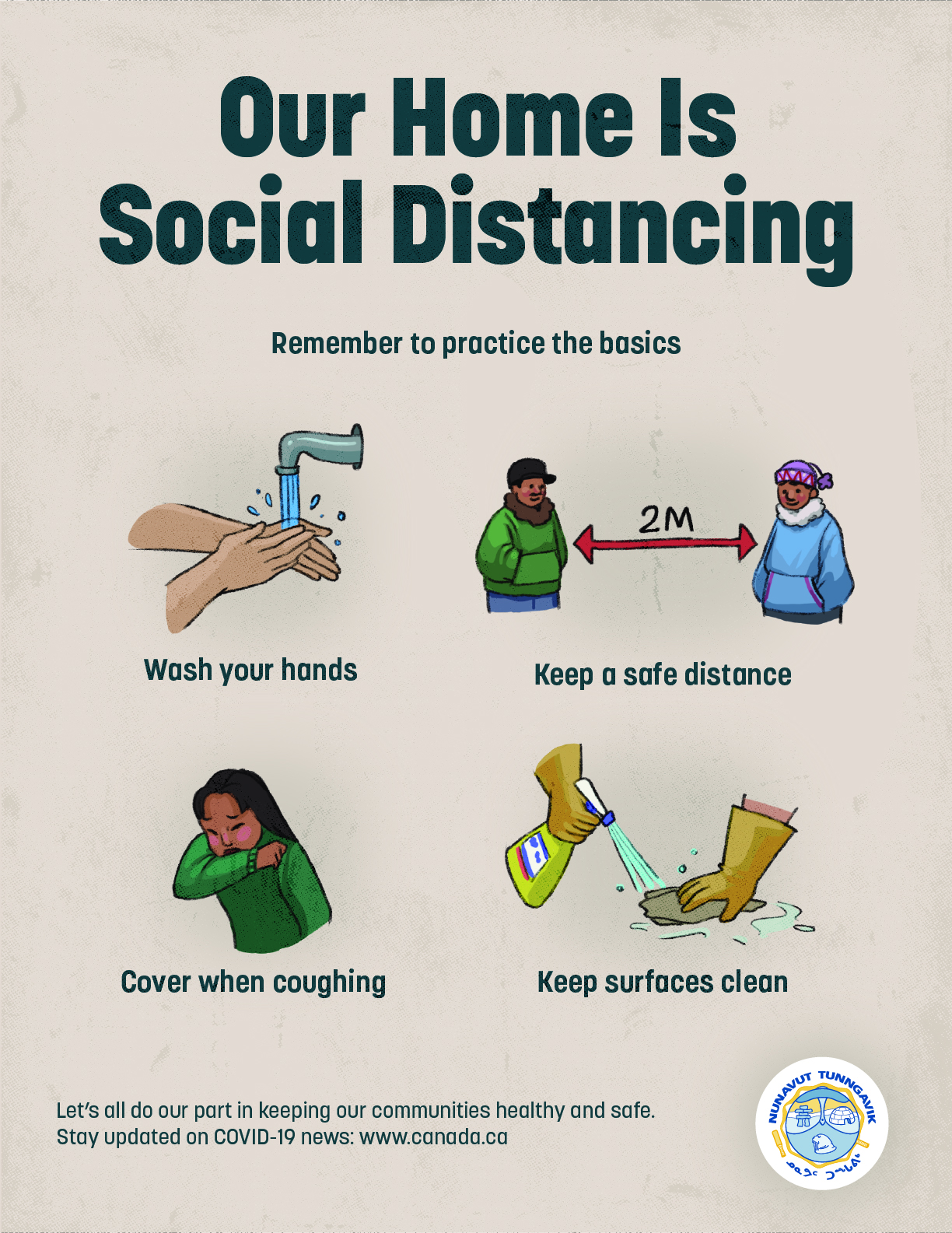
Our Home is Social Distancing
Our Home Is Social Distancing. Print the poster and stick it to your front door. Keep your home and community safe.

Our Home Is Social Distancing. We can still show love! Aqaq via phone, video or from outside through the window. Don’t kunik and hug.

Our Home Is Social Distancing. Keep Elders safe. Don’t ask Elders to babysit. Leave food and supplies at their door. Wave through the window and call them by phone.

Our Home Is Social Distancing. Wash your hands and divide what you want to share. Say no when someone says, “After You”.

Our Home Is Social Distancing. Wash your hands and use utensils to cut your child’s food. Don’t chew it for them.

Our Home Is Social Distancing. Remember to practice the basics. Wash your hands. Keep a safe distance. Cover when coughing. Keep surfaces clean
Nunavut Tunngavik Inc. and Inhabit Media, partner to launch online resource for home learning


Nunavut Tunngavik Inc. and Inhabit Media Inc. are committed to ensuring that Inuit children and youth have access to high-quality Inuktut books and educational resources to support language learning from home. As this need is now urgent due to the current COVID-19 crisis and the system-wide school closures in Nunavut, Nunavut Tunngavik Incorporated (NTI) and Inhabit Media have partnered to make Inuktut books readily available online at https://nti-inhabit.com
NTI is working with Inhabit Media and Inuit educators to create new educational resource packages to support Inuktut literacy development from home. Each week that this crisis continues new books and resources will be added to support Nunavummiut and ensuring our language remains strong.
“NTI is proud to contribute to Inuktut learning, connecting families and enabling all of us to stay at home as much as possible.”- Aluki Kotierk, NTI
“We want to support learning from home, and to encourage people to use this time to come together and strengthen our language.” —Louise Flaherty, Inhabit Media
ABOUT NUNAVUT TUNNGAVIK INCORPORATED (NTI):
NTI coordinates and manages Inuit responsibilities set out in the Nunavut Agreement and ensures that the federal and territorial governments fulfill their obligations.
ABOUT INHABIT MEDIA:
Inhabit Media Inc. is an Inuit-owned publishing company that aims to promote and preserve the stories, knowledge, and talent of northern Canada. Our mandate is to promote research in Inuit mythology and the traditional Inuit knowledge of Nunavummiut (residents of Nunavut). Our authors, storytellers, and artists bring this knowledge to life in a way that is accessible to readers in both northern and southern Canada. As the first independent publishing company in Nunavut, we hope to bring Arctic stories and wisdom to the world.
For more information from NTI:
Malaya Mikijuk
For more information from Inhabit Media:
Pia Flamand
NTI Statement regarding the Declaration of a Public Health Emergency
NTI Statement regarding the Declaration of a Public Health Emergency
Nunavut Tunngavik Incorporated (NTI) applauds the decision by the territorial Chief Public Health Officer to declare a public health emergency in Nunavut in response to the COVID-19 pandemic.
The Government of Canada must acknowledge and address Nunavut’s vulnerability to the COVID-19 pandemic by addressing the immediate risks, as well as persistent social and economic inequities faced by Nunavut Inuit which put Inuit at elevated risk.
Many Inuit are unable to take the most basic protective measures recommended by Canada’s Chief Public Health Officer. Public health information has not been effectively distributed in Inuktut, the majority language of the territory. In overcrowded homes, many Inuit are unable to distance socially and will not be able to self-isolate or quarantine. Similarly, many Inuit do not receive water and sewer services daily making handwashing difficult.
Chronic shortages of health care staff, inadequate health infrastructure, persistent food insecurity and a vulnerable supply chain into the territory would make a COVID-19 outbreak in Nunavut devastating.
Nunavut Inuit are strongly encouraged to do as much as they can to follow the instructions by the territorial Chief Public Health Officer, which includes: staying home, washing hands often, do not kunik children, and do not chew food for infants. For up to date instructions, visit www.gov.nu.ca.
-30-
For more information, please contact:
Malaya Mikijuk
A/ Director of Communications
Nunavut Tunngavik Incorporated
Tel: (867) 975-4900
https://www.tunngavik.com
Qajaaq Ellsworth
Senior Communications Advisor
Office of President Aluki Kotierk
Tel: (867) 222.3939
https://www.president.tunngavik.com
Effective March 18, 2020, and until further notice, Nunavut Tunngavik Incorporated (NTI) offices will be closed
Effective March 18, 2020, and until further notice, Nunavut Tunngavik Incorporated (NTI) offices will be closed and staff will be working from home to increase social distancing in light of the COVID-19 pandemic. If you need to contact NTI or NTI employees:
• Please use regular NTI email addresses that you normally use.
• For NTI-administered programs:
o Enrollment 1-888-236-5400
o NHSP 1-888-236-5400
o Scholarships 1-888-236-5400
o Elders’ Pension 1-888-236-5400
• If you need to call NTI, please call 1-888-646-0006
Katujjiqatigiinniq Protocol
Government of Nunavut and Nunavut Tunngavik Incorporated sign renewed protocol
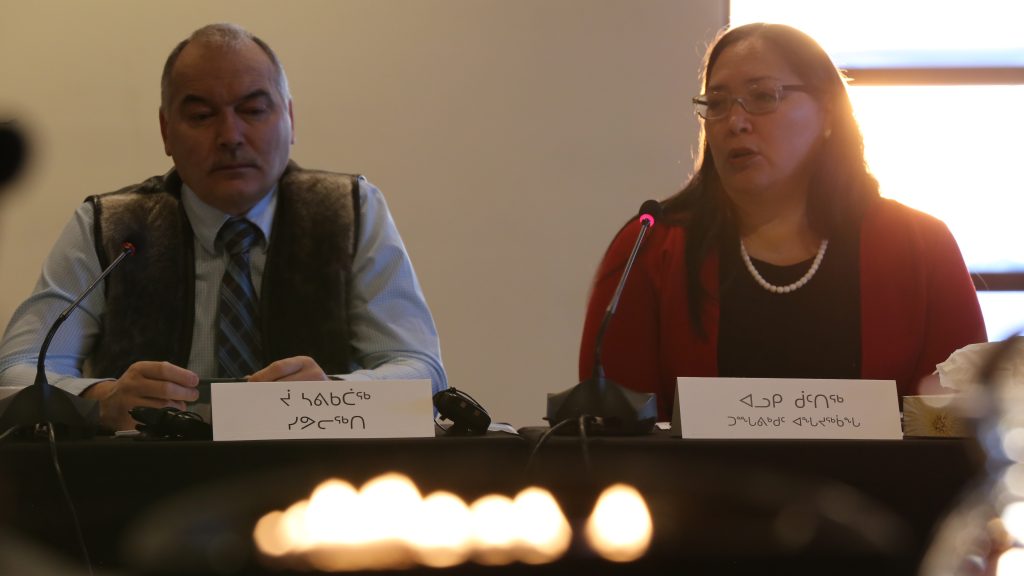
IQALUIT, Nunavut (January 21, 2017) – Nunavut Premier Joe Savikataaq and Nunavut Tunngavik Incorporated (NTI) President Aluki Kotierk signed the Katujjiqatigiinniq Protocol today, to help guide shared Inuit-Government goals to benefit Nunavut Inuit.
Specifically, Katujjiqatigiinniq helps shape the work around:
- the broad principles, priorities and bilateral mechanisms that will contribute towards productive working relationships and outcomes;
- making practical commitments in relation to leadership, oversight, and administration that will focus enhance working relationships and outcomes; and
- the Government of Nunavut (GN) and NTI’s continued implementation of the Nunavut Agreement, including Article 32 and the development of an Article 32 policy and joint Information Sharing Agreement.
“Nunavut Inuit have the right to participate in the development of social and cultural policies, and in the design of social and cultural programs and services, including their method of delivery,” says NTI President Kotierk. “The Katujjiqatigiinniq Protocol signals our shared commitment to work together for the full and effective implementation of the Nunavut Agreement.”
“The GN and NTI have a long history of common priorities, strong leadership and collaboration to advance Nunavut’s needs,” said Premier Savikataaq. “I am ready to move forward with renewed commitments and a greater voice to make positive impacts for Nunavummiut. Our passions and dedication are more effective when we use our platform together.”
NTI and the GN previously entered into the Clyde River Protocol in 1999, Iqqanaijaqatigiit in 2004 and Aajiiqatigiinniq in 2011, to ensure positive working relationships. Katujjiqatigiinniq is available online at https://president.tunngavik.com/files/2020/01/Katujjiqatigiinniq-Protocol-English.pdf.
For more information, contact:
Cate Macleod
Press Secretary
Office of Premier Savikataaq
867-975-5059
Qajaaq Ellsworth
Senior Communications Advisor
Office of the President
Nunavut Tunngavik Incorporated
867-975-4955
Self-Determination the focus of 2019 AGM
(October 24, 2019 – Rankin Inlet, Nunavut) On the conclusion of the 2019 Annual General Meeting of Nunavut Tunngavik Inc. (NTI), President Aluki Kotierk recognized Inuit interest for self-determination.
“Members remain optimistic that Inuit culture and language will remain strong in the territory of Nunavut, but recognize that the way forward will require innovation and urgent work,” said President Kotierk. “Inuit call for the Government to work with us to address the issues of education, Inuit employment, early learning and justice. Inuit expect equity and to be full participants in decisions affecting them.”
During the AGM, Members passed resolutions, including:
- On Education, for the Standing Committee, the Territorial Leader, the Minister of Education and the Members of the Nunavut Legislative Assembly to withdraw Bill 25 and to work with NTI to table the Nunavut Education Reform Act as a new education bill that is responsive to Inuit concerns.
- On Inuit employment, for the Governments of Canada and Nunavut to take immediate actions to fully implement Article 23 of the Nunavut Agreement including how and by when each government department will increase Inuit employment to a representative level.
- On Inuit Early Learning and Childcare (IELCC), for the GN to make significant investments, including the construction of new child care centres, to work with Inuit under Article 32 of the Nunavut Agreement in the implementation of the Inuit Early Learning and Childcare Framework, and the Minister of Education to fulfill its Inuit Language obligations in IELCC in Nunavut.
- On Justice, for the GoC and GN to provide services in Inuktut in the administration of justice to serve the needs of Inuit offenders including increasing participation of Inuit in the full spectrum in the administration of justice, restorative justice initiatives and community reintegration programs. The members also call upon the Governments to ensure each community are provided adequate resources to support fully functioning community justice committees.
The next AGM will in Cambridge Bay, Nunavut, from October 20-22, 2020.
For further information:
Malaya Mikijuk
Assistant Director of Communications
Nunavut Tunngavik Incorporated
Tel: 867-975-4907
www.tunngavik.com
NTI statement on federal election results
For Immediate Release:
(October 23, 2019) President Aluki Kotierk, on behalf of Nunavut Inuit, congratulates Mumilaaq Qaqqaq on her election as Member of Parliament for Nunavut and Prime Minister Justin Trudeau and the Liberal party on their election to another term.
To MP-elect Qaqqaq, President Kotierk commented, “As you embark on your new role, we are committed to working with you to achieve the full implementation of the Nunavut Agreement. It was young Inuit, a generation ago, whom led the charge to negotiate and settle the Nunavut Agreement. We have much more work to fully realize the Nunavut dream. I am confident that your understanding of the issues and concerns important to Inuit, and our willingness and ability to work together will serve us all well.”
On the re-election of the Liberal party Kotierk added, “Inuit have made progress through the Inuit-Crown Partnership Committee (ICPC) which was exceptionally successful and delivered on its objective to close the unacceptable social and economic inequities faced by Inuit. I want to congratulate Prime Minister-elect Justin Trudeau and the Liberal party in their re-election to another term as government. We are eager to continue to work in partnership to respect and advance Inuit rights and interests”.
Nunavut Tunngavik Incorporated’s (NTI) Niriuttaarijat strategic priorities (2018-2021) are Inuit employment, a Nunavut education system reflective of Inuit culture, Inuktut as the primary working language of the territory, closing the infrastructure gap and full implementation of Article 32 of the Nunavut Agreement.
NTI coordinates and manages Inuit responsibilities set out in the Nunavut Agreement and ensures that the federal and territorial governments fulfill their obligations.
“I thank the other three candidates for the Nunavut riding, Leona Aglukkaq, Megan Pizzo-Lyall and Douglas Roy for their commitment to Nunavut Inuit and the democratic process,” said Kotierk.
For further information:
Malaya Mikijuk
Assistant Director of Communications
Nunavut Tunngavik Incorporated
Tel: 867-975-4907
www.tunngavik.com
Nunavut Tunngavik Incorporated’s (NTI) 2018-2019 fiscal year a financial milestone
For Immediate Release:
(October 22, 2019 – Rankin Inlet, Nunavut) Nunavut Tunngavik Incorporated’s (NTI) 2018-2019 fiscal year was a financial milestone. The long-term loan from the Nunavut Trust has been paid off and there is a budget surplus of $27,275,520.
“This achievement is the result of a joint effort between the Nunavut Trust, NTI and the Regional Inuit Associations,” said NTI President Aluki Kotierk. “The membership today decided to allocate these funds in two ways. Inuit are investing half towards fulfillment of NTI’s strategic priorities, while the other half will allow us to reduce the likelihood of another long-term loan by establishing an Operating Fund.”
NTI’s Niriuttaarijat strategic priorities are Inuit employment, a Nunavut education system reflective of Inuit culture, Inuktut as the primary working language of the territory, closing the infrastructure gap and full implementation of Article 32.
Clear vision and sound management of Nunavut Inuit assets further enable Regional Inuit Associations to deliver programs and services to Nunavut Inuit in their region, while NTI fulfills the central function of planning, advocating and monitoring for results.
The Operating Fund will help to move Inuit organizations away from requiring short-term advances for annual operations, which will, in turn result in more funds for the Nunavut Trust to invest. Kotierk adds, “Thank you to Nunavut Trust, to our membership and to everyone who worked towards getting us to this point.”
The Long-Term Loan
Backgrounder
When the Nunavut Agreement was signed, Section 29 set out a schedule of payments that were made by the Government of Canada to the Nunavut Trust between 1993 and 2007. The Trust’s role is to invest this money, provide income to Nunavut Tunngavik Incorporated (NTI) and protect the capital. In the beginning, the Trust did not earn enough to fully fund the operations of NTI, Inuit Heritage Trust (IHT), Qikiqtani Inuit Association (QIA), Kitikmeot Inuit Association (KIA) and Kivalliq Inuit Association (KIA).
The Nunavut Trust, NTI and Regional Inuit Associations (RIAs) agreed that NTI would temporarily borrow Trust capital for the early years, which also included funds required for NTI’s $70 Million capital investment in Atuqtuarvik Corporation, a funding agency for small Inuit businesses. This is called the long-term loan.

In some years, the Trust earns more than anticipated, or the Inuit organizations requests less than the distribution. In these years, the extra income is used to pay down the long-term loan. In other years, the trust earns less than anticipated, or the Inuit organizations request more than the distribution and the long-term loan increases. There were several years that the budget requests were larger than the distribution and the long-term loan increased to $119,046,268 in 2005.
Since then, the Nunavut Trust modified its investment strategy to stabilize the income.
NTI Board of Directors have also taken steps to responsibly manage its finances. Currently, the Inuit organizations receive a short-term advance from the Nunavut Trust for annual operations. Figure 2 outlines the timing. The advance is an estimated 4% of the capital of the Trust assets. Of this amount, the Board set aside at least 5% annually towards repaying the long-term loan.
As a result of a combination these factors, fiscal 2018-2019 saw the long-term loan paid off and a surplus generated.
-30-
For further information:
Malaya Mikijuk
Assistant Director of Communications
Nunavut Tunngavik Incorporated
Tel: 867-975-4907
www.tunngavik.com
Nunavut Tunngavik Audio Broadcasting
Nunavut Tunngavik Incorporated – Rankin Inlet, October 21 – 24 2019
Niriuttaarijat – Nunavut Tunngavik Incorporated 2018–2021 Priorities
NIRIUTTAARIJAT
NUNAVUT TUNNGAVIK INCORPORATED
2018–2021 PRIORITIES
- INTRODUCTION
Nunavut Tunngavik Inc. (NTI) Board of Directors met on July 26 and 27, 2018 to set organizational priorities for NTI for the period of Fall 2018 to March 2021. This document represents the outcome of the meeting.
NTI will continue to work in constructive and creative partnership with the Government of Canada and Government of Nunavut in the priority areas identified in this document, full and fair implementation of the Nunavut Agreement and safeguard of Inuit rights under the Nunavut Agreement will continue to be the central part of NTI’s core functions and responsibilities.
- 2018–2021 PRIORITIES
The following are NTI organizational priorities for 2018–2021.
- We will seek to work with the Governments of Canada and Nunavut to achieve substantial and measurable progress towards the full implementation of Article 23 of the Nunavut Agreement.
Inuit employment and full implementation of Article 23 are the essential means to address many of the prevailing issues in Inuit society today. Members also discussed the need to radically transform the government work force and the existing bureaucratic culture.
To make substantial progress on Inuit employment in the next three years, we will collaborate with the Governments to:
- develop and implement robust Inuit Employment Plans and Pre-Employment Training Plans;
- take concrete steps towards making Inuktut the primary language of work in the Government of Nunavut;
- enact of an Inuit Employment Act; and
- reform the primary education system in Nunavut.
- We will seek to make significant progress in strengthening Inuktut in all aspects of life in Nunavut, including Nunavut’s education system, public service workplaces, and delivery of essential government programs and services.
Inuit are rebuilding our pride in our Inuit identity which has been damaged by colonialism and past government policies of assimiliation.
Inuktut is an essential and central part of rebuilding Inuit identity. Inuit culture, history, traditions and values are embodied in and conveyed through our language.
It is well documented that Inuktut use has been in a state of decline. Urgent and serious efforts are needed to reverse this.
Therefore, it is essential that we try all available means, through urgent and concern actions, to make substantial progress towards:
- making Inuktut the primary language of instruction in Nunavut schools;
- making Inuktut an official language of Canada in Nunavut;
- making Inuktut the primary language of work in government offices; and
- making Inuktut the primary language for delivery of essential government programs and services including health care, education and justice in Nunavut;
- We will seek to work with the Governments of Canada and Nunavut to create an education system that reflects and promotes Inuit priorities and Inuit culture.
In order to keep our children in school it is crucial to develop school curriculum centered on Inuit culture, and to encourage and support Inuit children and youth to pursue and succeed in all levels of education.
To that end, we will seek to:
- collaborate with the Government of Nunavut in the Education Act Review process to make important reforms in the primary education system in Nunavut that reflect Inuit priorities (e.g., measurable steps towards making Inuktut the primary language of instruction in Nunavut schools);
- collaborate with the federal and territorial governments to make significant investment in new training programs for Inuktut-speaking teachers; and
- collaborate with the federal and territorial governments to take significant steps to strengthen Inuktut in daycares in Nunavut.
- We will seek to work with the Governments of Canada and Nunavut to make substantial progress in narrowing housing and other infrastructure gaps in Nunavut, and raising infrastructure standards in Nunavut up to national levels.
There is an urgent need to establish the basic infrastructures in Nunavut that include but are not limited to:
- Roads and Ports
- Housing
- Elders Facilities
- Wildlife Research/Testing Facilities
- Heritage/Culture Centres
- Addition/Treatment Centres
- Youth Facilities
- Hydroelectric Facilities
- Fiber Optics Network or High Speed Internet
The lack of basic infrastructures has seriously impaired Nunavummiut’s ability to better themselves, to improve their well-being and standard of living, to fight poverty and food insecurity, and to compete in a modern economy.
In the next three years, we will:
- collaborate with the governments to develop an Inuit Nunangat Housing Strategy, to supplement the National Housing Strategy and the GN’s Blueprint for Action on Housing;
- collaborate with the governments to develop a Long Term Infrastructure Strategy and to start early implementation of the Strategy and development of strategic projects; and
- collaborate with governments and private sector to establish a strategic development fund for major infrastructure projects in Nunavut.
- We will seek to work with the Governments of Canada and Nunavut to create Article 32 protocol to promote meaningful Inuit participation in the development of social and cultural policies and programs in Nunavut.
Government policies and programs must reflect and promote Inuit societal values, culture and traditions. Meaningful Inuit participation in this regard is an important means to redress past harm and historical wrongs that have been done to Inuit society, and to achieve the broader goal of reconciliation.
Expressions of Interest – 2 representatives to join the Nunavummi Nangminiqaqtunik Ikajuuti (NNI) Tribunal
Nunavut Tunngavik Inc. (NTI) is inviting expressions of interest for two (2) individuals to act as Independent tribunal representatives outlined in the Nunavummi Nangminiqaqtunik Ikajuuti (NNI) Regulations.
An independent NNI Tribunal (the “Tribunal”) hears and decides on complaints regarding the application of the NNI in the award of any contracts covered by the NNI
The NNI Regulations are the Government of Nunavut’s and Nunavut Tunngavik Inc. preferential contracting policy designed to meet the objectives of Article 24 of the Nunavut Agreement.
Interested candidates must be familiar with Article 24 of the Nunavut Agreement, the NNI regulations, and Nunavut contracting procedures.
For more information or to submit resumes, please contact:
Evie Eegeesiak
Tel: (867) 975-4900
Revitalizing and Strengthening Inuktut in Nunavut
Nunavut, September 8, 2019
The Government of Canada, the Government of Nunavut, and Nunavut Tunngavik Incorporated are collaborating toward an agreement that will support, revitalize and strengthen Inuktut in Nunavut.
In accordance with section 9 of the Indigenous Languages Act, the pathfinder agreement seeks to support:
- increasing access to Inuktut-language instruction in Nunavut;
- increasing and maintaining the number of proficient Inuktut-speaking Inuit educators;
- increasing the number of fluent Inuktut speakers in Nunavut; and
- establishing the Nunavut Partnership Table on Language and Education.
Subject to the details of an agreement to be finalized by the Nunavut Partnership Table on Language and Education, the Government of Canada is pleased to announce it would commit up to $42 million dollars over a five-year period to support this work.
Over the same period, the Government of Nunavut will invest a total of $25 million to introduce a new laddered approach to the Nunavut Teacher Education Program where students can work towards various levels of certification: a Nunavummi Inuktut Uqariuqsatittijiunirmut Ilinniarniq certificate, a language specialist diploma or a bachelor of education degree.
This collaboration is one of the first implementation actions of the Indigenous Languages Act, which was granted Royal Assent in June 2019. The Act aims to support the efforts of Indigenous Peoples to reclaim, revitalize, maintain and strengthen their languages.
Quotes
“Language is core to Indigenous Peoples’ identity and culture. Our government has committed to supporting the reclamation, revitalization, strengthening and maintenance of Indigenous languages. We are proud to be taking concrete action so soon after the Indigenous Languages Act received Royal Assent. The Act provides the flexibility to develop these agreements and to make targeted investments in Indigenous languages. Together with our partners, the Government of Nunavut and Nunavut Tunngavik Incorporated, we are ensuring that Inuktut continues to be strengthened in Nunavut for this generation and those to come.” — The Honourable Pablo Rodriguez, Minister of Canadian Heritage and Multiculturalism
“The Government of Nunavut is pleased to be a part of an important partnership that focuses on the development of Inuktut. This is a topic close to the heart of Nunavummiut. Under the Turaaqtavut Mandate, and in keeping with the guiding principles of Ikajuqtigiinniq—working together for a common cause—Nunavut Arctic College is working with the GN departments of Culture and Heritage, Human Resources and Education to further language training in our Community Learning Centres and campuses throughout Nunavut.” — The Honourable Patterk Netser, Minister Responsible for the Nunavut Arctic College
“Nunavut has been leading efforts to protect and promote the quality and prevalent use of Inuktut through its language and education laws. With this collaboration, we will continue our journey to strengthen the delivery of bilingual education in Nunavut. I am pleased that as a government, we will be creating a new generation of language champions for our schools and communities, while increasing our capacity to educate our children in Inuktut. I also look forward to developing a long-term plan with our partners to ensure that adequate and sustained resources will be provided to the territory to enable a more complete implementation of our language and education obligations.” — The Honourable David Joanasie, Minister of Education, Culture and Heritage, and Languages
“I am pleased with the investment commitment to teacher training in Nunavut, particularly as we embark on the path to reconciliation. Inuktut must become the first language in Nunavut schools according to the Education Act and the Inuit Language Protection Act, and I believe this is a good concrete step towards realizing that. We can achieve our goals when we work together; as such, I am equally pleased with the creation of the Nunavut Partnership Table on Language and Education. We are committed to ensure teacher training will be scaled up to more Nunavut communities following ongoing research, development, planning and implementation, monitoring and evaluation by the Nunavut Partnership Table on Language and Education.” — Aluki Kotierk, President, Nunavut Tunngavik Incorporated
Quick Facts
The United Nations Educational, Scientific and Cultural Organization (UNESCO) has declared 2019 the International Year of Indigenous Languages. According to UNESCO, three out of four of the 90 Indigenous languages in Canada are considered endangered.
In 2016, only about 15.6 percent of Indigenous people in Canada could converse in an Indigenous language, down from 17 percent in 2011 and 21 percent in 2006.
In 2016, 23,225 Nunavut residents (65.3 percent of the population) reported Inuktut as their mother tongue. This proportion is down from 71.7 percent in 2001.
Just over three-quarters of Nunavut Inuit (76.6 percent) reported Inuktut as their mother tongue in 2016, which means that Inuktut was not transmitted as a mother tongue to 23.4 percent of Inuit, or 7,075 people.
In 2016, 76.8 percent of the Nunavut population reported being able to conduct a conversation in Inuktut. This proportion was down from 79.0 percent in 2001.
On June 21, 2019, the Governor General of Canada granted Royal Assent to the Indigenous Languages Act. Since 2017, Canadian Heritage has worked with national Indigenous organizations to develop this historic legislation.
Budget 2019 committed $333.7 million over five years, starting in 2019–2020, and $115.7 million per year ongoing to support the implementation of the Indigenous Languages Act.
Associated Links
Government of Nunavut: http://www.gov.nu.ca/
Nunavut Tunngavik Incorporated: https://www.tunngavik.com/
Let’s celebrate Indigenous languages in Canada: https://www.canada.ca/en/canadian-heritage/campaigns/celebrate-indigenous-languages.html
Indigenous Languages Act: https://www.parl.ca/DocumentViewer/en/42-1/bill/C-91/royal-assent
UNESCO International Year of Indigenous Languages: https://en.unesco.org/IY2019
For more information (media only), please contact:
Simon Ross
Press Secretary
Office of the Minister of Canadian Heritage and Multiculturalism
819-997-7788
Media Relations
Canadian Heritage
819-994-9101 1-866-569-6155
Government of Nunavut
867-975-6000
1-877-212-6438
John Fawcett
Acting Director
Nunavut Tunngavik Incorporated
867-975-4900
1-888-646-0006
Nunavut Tunngavik Incorporated, and the Governments of Canada and Nunavut Sign Inuit Impact Benefit Agreement for Canadian Heritage Rivers
News Release
For Immediate Release
Nunavut Tunngavik Incorporated, and the Governments of Canada and Nunavut Sign Inuit Impact Benefit Agreement for Canadian Heritage Rivers
July 9, 2019 — Kugluktuk, NU
Crown-Indigenous Relations and Northern Affairs Canada
Government of Nunavut
Nunavut Tunngavik Incorporated
For countless generations Inuit have relied on the land, sea and water ways as active stewards of the lands and waters in and around Nunavut. On this Nunavut Day, the Government of Canada, the Government of Nunavut and Nunavut Tunngavik Incorporated (NTI) have taken an important step towards fulfilling obligations set out in the Nunavut Agreement by signing an agreement to ensure continued Inuit participation in management of Canadian Heritage Rivers in the Nunavut Settlement Area.
Today, Aluki Kotierk, President of NTI, the Honourable Carolyn Bennett, Minister of Crown-Indigenous Relations, and the Honourable Jeannie Hakongak Ehaloak on behalf of the Honourable Joe Savikataaq, Premier and Environment Minister of Nunavut, joined with community members to celebrate the signing of the Canadian Heritage Rivers Inuit Impact Benefit Agreement (IIBA).
The settlement of this IIBA fulfills obligations set out in the Nunavut Agreement to negotiate an IIBA for any national park or conservation area established in the territory. Overseen by Parks Canada and provincial and territorial governments, with the support of the Canadian Heritage Rivers Board, the Canadian Heritage River System recognizes Canadian rivers that are of importance to Indigenous people, explorers, settlers, industry, and the economy.
Canada will provide $6.7 million to NTI, Kivalliq Inuit Association, the Qikiqtani Inuit Association, and the Kitikmeot Inuit Association for implementation of the IIBA. Funding will support activities such as Heritage Rivers water quality monitoring, Inuit cultural camps for adjacent communities, and the establishment of a business opportunities fund. Canada will also provide the Government of Nunavut with funding for incremental activities associated with the implementation of the IIBA.
The settlement and signing of this agreement demonstrates the parties’ commitment to recognizing and respecting Inuit history of land and water use in the area. Provisions of the agreement support Inuit participation in conservation and economic activities which build tourism expertise and support business development.
Quotes:
“These rivers have been, and continue to be, important transportation routes, particularly in the face of infrastructure deficits in Nunavut. Through signing of this IIBA and by recognizing Inuit history, use and management of these Heritage Rivers, we are contributing towards implementation of the Nunavut Agreement while promoting and conserving lands and waters and maximizing benefits to Nunavut Inuit. Further, in 2019 – the International Year of Indigenous Languages – our agreement also allows for formal adoption and use of Inuit place names – in the case of Nunavut’s Canadian Heritage Rivers: Qurluktuk, Sarvaqtuuq, Kuujjuaq and Akillinik.”
Aluki Kotierk – President, Nunavut Tunngavik Incorporated
“Inuit involvement in the management of territorial lands and resources leads to increased investment and economic growth, and ultimately more job opportunities. With this agreement, we are honouring our obligations to Inuit and working collaboratively to increase the participation of Inuit in river management and conservation for the benefit of all Canadians.”
The Honourable Carolyn Bennett, M.D., P.C., M.P.
Minister of Crown-Indigenous Relations
“This is an important commitment towards the ongoing stewardship of Canadian Heritage Rivers in Nunavut, supporting economic benefits and traditional activities for Inuit. The water here is a vital resource and tells the story of our country, land and people. I encourage Canadians to visit and learn about the importance of Canadian Heritage Rivers.”
The Honourable Catherine McKenna
Minister of Environment and Climate Change and Minister responsible for Parks Canada
“The Government of Nunavut is committed to working closely with our partners to ensure that Nunavummiut benefit from the Canadian Heritage River System. These are places where we live, fish, hunt, and seek out recreation and solace. By signing this IIBA, we are taking steps to sustainably manage Nunavut’s Heritage Rivers, so that our children, and their children may continue to enjoy the land well into the future.”
The Honourable Jeannie Ehaloak, Minister of Justice on behalf of The Honourable Joe Savikataaq, Minister of Environment and Premier of Nunavut Government of Nunavut
Quick Facts:
• The Nunavut Agreement requires that, before a national park or conservation area is established in the Nunavut Settlement Area, Inuit and Canada negotiate an Inuit impact and benefit agreement.
• An Umbrella Inuit Impact and Benefit Agreement for Canadian Heritage Rivers in Nunavut covers the following Nunavut rivers: the Coppermine River (Qurluktuk), the Kazan River (Sarvaqtuuq), the Soper River (Kuujuaq) and the Thelon River (Akillinik).
• The Impact and Benefit Agreement includes any matter connected with the proposed conservation area that would have a detrimental impact on Inuit, or that could reasonably provide a benefit on Inuit, including: cooperative management, continuation of Inuit harvesting rights, and Inuit employment and economic benefits.
• The Canadian Heritage Rivers System is a federal-provincial-territorial government program that works with community-level river stewardship groups to promote and conserve rivers with outstanding natural, cultural and recreational values in a way that recognizes the contributions of Inuit, their histories and cultures, and supports greater Inuit participation in the benefits arising from their use.
• “Nunavummiut” is the Inuktut word for residents of Nunavut.
Associated Links:
Nunavut Agreement
Canadian Heritage Rivers System
Nunavut Tunngavik Incorporated (NTI)
For more information, media may contact:
Matthew Dillon-Leitch Director of Communications
Office of the Honourable Carolyn Bennett Minister of Crown-Indigenous Relations
819-997-0002
Media Relations
Crown-Indigenous Relations and Northern Affairs Canada
819-934-2302
Karen Flaherty
Manager, Communications, Education and Outreach
Government of Nunavut
867-975-7761
Oo Aqpik
Director of Communications
Nunavut Tunngavik Incorporated
1-888-646-0006
Stay connected, join the conversation about Indigenous peoples in Canada:
Twitter: GovCan – Indigenous, Canadian Heritage Rivers System, Nunavut Tunngavik Incorporated, Government of Nunavut
Facebook: GovCan – Indigenous Peoples, Canadian Heritage Rivers System, Nunavut Tunngavik Incorporated, Government of Nunavut
Instagram: @gcIndigenous, Canadian Heritage Rivers System


Affirming the Aspiration of Nunavut
(July 9, 2019 – Kugluktuk, Nunavut)
The aspiration of Nunavut is a step closer as Nunavut Tunngavik Incorporated (NTI) seeks guidance for self-government from Inuit Elders and commits to becoming an Inuktut language workplace announced President Aluki Kotierk from Kugluktuk today.
“Fifty years ago, Tagak Curley wrote to Elders seeking their vision and goals,” said President Aluki Kotierk. “These letters inspired hope. Inuit organized and began negotiations which resulted in the signing of the Nunavut Agreement twenty-six years ago. Today, we seek guidance on self-government and have written to our Elders.”
In 1970, the Elders’ responses received by Tagak Curley led to the Conference of Arctic Native People in Coppermine, known as the Coppermine Conference. Today, Coppermine is known by its Inuinnaqtun name, Kugluktuk.
“One of the aspirations for Nunavut was for Inuktut to remain the majority language and its use in workplaces, schools and the public,” said Vice-President James Eetoolook. “We are leading by example and commit to being an Inuktut-first workplace.”
Inuktut language assessments have been completed with NTI staff. All staff will receive on the job training and support based on their needs. New terminology in technical fields, finance and law will be developed. More than 200 hours in Inuktitut training have been delivered with Inuit staff of NTI in the past two years.
“As identified in the study on the education system, ‘Nunavut has a history of cultural genocide, linguicide, econocide and historicide, and this continues,’” said Kotierk. “We can no longer wait for governments to deliver on their promises. We must take action.”
For further information:
Kilikvak Kabloona
Chief Executive Officer
Nunavut Tunngavik Incorporated
Qajaaq Ellsworth
Senior Communications Advisor
Office of President Aluki Kotierk
BACKGROUNDER
‘Nunavut has a history of cultural genocide, linguicide, econocide and historicide, and this
continues.’ quoted from Is Nunavut’s Education Criminally Inadequate? page 68.
https://www.tunngavik.com/files/2019/04/NuLinguicideReportFINAL.pdf
United Nations Declaration on the Rights of Indigenous People, select Articles:
Article 3
Indigenous peoples have the right to self-determination. By virtue of that right they freely
determine their political status and freely pursue their economic, social and cultural development.
Article 4
Indigenous peoples, in exercising their right to self-determination, have the right to autonomy or
self-government in matters relating to their internal and local affairs, as well as ways and means
for financing their autonomous functions.
Article 7
1. Indigenous individuals have the rights to life, physical and mental integrity, liberty and security
of person.
2. Indigenous peoples have the collective right to live in freedom, peace and security as distinct
peoples and shall not be subjected to any act of genocide or any other act of violence, including
forcibly removing children of the group to another group.
Article 8
1. Indigenous peoples and individuals have the right not to be subjected to forced assimilation or
destruction of their culture.
Article 13
1. Indigenous peoples have the right to revitalize, use, develop and transmit to future generations their histories, languages, oral traditions, philosophies, writing systems and literatures, and to designate and retain their own names for communities, places and persons.
2. States shall take effective measures to ensure that this right is protected and also to ensure that indigenous peoples can understand and be understood in political, legal and administrative proceedings, where necessary through the provision of interpretation or by other appropriate
means.
Article 14
1. Indigenous peoples have the right to establish and control their educational systems and institutions providing education in their own languages, in a manner appropriate to their cultural
methods of teaching and learning.
2. Indigenous individuals, particularly children, have the right to all levels and forms of education of the State without discrimination.
3. States shall, in conjunction with indigenous peoples, take effective measures, in order for indigenous individuals, particularly children, including those living outside their communities, to have access, when possible, to an education in their own culture and provided in their own language.
Article 21
1. Indigenous peoples have the right, without discrimination, to the improvement of their economic and social conditions, including, inter alia, in the areas of education, employment, vocational training and retraining, housing, sanitation, health and social security.
Article 23
Indigenous peoples have the right to determine and develop priorities and strategies for exercising their right to development. In particular, indigenous peoples have the right to be actively involved in developing and determining health, housing and other economic and social programmes affecting them and, as far as possible, to administer such programmes through their own institutions.
Truth and Reconciliation Commission, select Calls to Action
43) We call upon the federal, provincial, territorial and municipal governments to fully adopt and implement the United Nations Declaration on the Rights of Indigenous Peoples as the framework for reconciliation.
Inuktut First
The use of Inuktut has been declining as a result of colonial practices, such as residential schools and a continuing educational system based in English or French. As a result, Inuktut proficiency varies across the NTI offices. Phased-in training will be delivered, based on three categories of investments:
1) Supporting the strong core group of fluent Inuktut speakers to become literate. They will be the ones who model a ‘working environment’.
2) Supporting non-fluent Inuit. This group is smaller than the core group of fluent Inuktut speakers. This is where NTI has the most experience in training and has demonstrated outcomes.
3) Supporting beginners. These staff will start with foundations training. This is the smallest group.
NTI’s commitment includes amending the human resource manual to support language training delivered by Pirurvik Centre.
Creating Employment Opportunities for Inuit Through Inuktut Skills
Additionally, an implementation coordinator will develop training plans, deliver or coordinate language tranings, and work to support the Inuktut working environment.
Hope, Optimism, and a plan for a TB-free Nunavut
For Immediate Release
Hope, Optimism and a plan for a TB-free Nunavut
(March 24, 2019 – Iqaluit, Nunavut)
March 24th is World Tuberculosis (TB) Day.
“This World TB Day is a time of hope and optimism for a TB-free Nunavut – for ourselves, for our children and for generations to come,” said Nunavut Tunngavik Incorporated (NTI) President Aluki Kotierk. “I take this opportunity to reassure Nunavut Inuit that we now have tools for TB diagnosis and treatment that happens in our communities. Let us eliminate TB together! I encourage Nunavummiut to get tested for this treatable infection.”
NTI commits to advancing our work on addressing food insecurity through reclaiming food sovereignty, housing and poverty reduction; all of which have been identified as areas that contribute to these high rates of TB. We will continue to work collaboratively with our partners to strengthen our social determinants of health as Inuit.
Last year on World TB Day, Inuit Tapiriit Kanatami and the Federal Government jointly announced a commitment to cut the incidence of Inuit with TB across Inuit Nunangat in half by 2025, and to eliminate TB by 2030. Budget 2018 followed with $27.5 million to begin Inuit TB elimination efforts. ITK released the Inuit TB Elimination Framework in December 2018 which will include a Nunavut specific action plan in the coming months, developed by NTI and the Government of Nunavut collaboratively.

For further information:
Franco Buscemi
Interim-Director of Communications
Nunavut Tunngavik Incorporated


